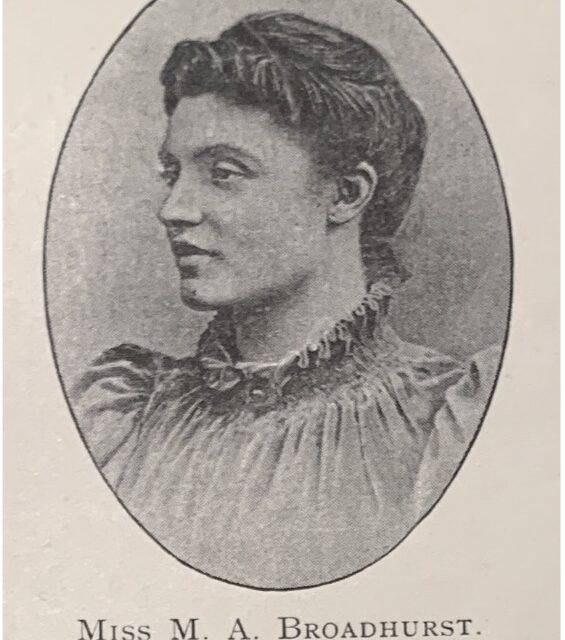
(Image – The Sphinx Magazine, Special Collections and Archives, University of Liverpool Library, PUB 3/2/2).
International Women’s Day has arrived. What better time to celebrate one of our own? Read about one of the first women students to study at the Victoria Building when it opened in 1982. Our subject for today is more than just a University of Liverpool alum; she’s The Sphinx’s founder. Read all about Mary Adelaide Broadhurst.
Mary Adelaide Broadhurst was born in Chorlton-on-Medlock, Manchester in 1860 and first appears in our records at the university in 1889, so by the time she was studying at University College Liverpool, she was around 29 years old.
University of Liverpool Law Professor Walter Lyon Blease was a former student and became friends with Mary Adelaide. In a 1913 book that he dedicated to her called ‘The Emancipation of British Women’ he detailed how difficult it was for women in higher education during the late 1800s as women were not allowed to attend some universities or get a degree. Many female students at other institutions had been subjected to verbal and physical violence from male students and even some teaching staff as they were pelted with mud, rotten eggs and fireworks during riots.
The female students at Liverpool were pioneers in a number of areas and Blease stated the following:
“At Liverpool alone are women precisely upon an equality with men, sitting with them upon the Students Representative Council, and taking an equal part in the regulation of the social life of the university. But in winning these privileges for herself and her fellow students, Miss Mary Adelaide Broadhurst had to meet and overcome the same difficulties as those which women previously encountered at Edinburgh and Cambridge. Probably every woman who has done pioneer work of this kind in the universities has faced the same resentful bewilderment, the same unreasoning wonder that she should wish for freedom to think and act for herself.”
Even from University College Liverpool’s very early days, prior to becoming The University of Liverpool, it is evident that the female students took on a lot of responsibility and Mary Adelaide is mentioned in many of the student magazine articles getting involved with numerous functions and committees in 1892.
During her time as a student she had many different roles including president of the debating society, secretary to the student council, furnishing committee member, editor of The Sphinx student magazine and finally president of the Women Student’s Representative Council. It is not surprising that at the end of her term, The Sphinx magazine reported that they were to lose one of their most trusted leaders and that she would leave a gap that would be very hard to fill.

(Image – The women’s common room, Victoria Building circa 1892, Special Collections and Archives, University of Liverpool Library, P2059/1 and Illustration by Michelle Keeley Adamson)
A student Furnishing Committee was established in 1892 just as the Victoria Building had opened its doors and Mary Adelaide was very much involved in raising money. During the Autumn term of 1893, the women’s room was furnished with comfortable chairs, plants, a tea service and flower stands and the magazine stated these contributions would be beneficial for generations of students to come.
One article from 15 March 1893 stated that the women had been told by the male editors that their section needed to be cut down and so they couldn’t explain in great detail what furnishing had been accomplished due to lack of space. As Mary Adelaide was a chief contributor and editor of the magazine for 5 years, we can only guess that this quip might have been written by her. As there are a lack of photographs from this period, The Sphinx magazine articles are valuable for finding out about early student life.
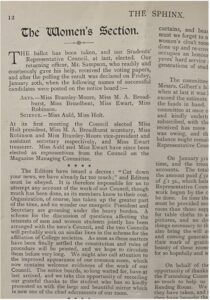
(Image – The Sphinx Magazine, Special Collections and Archives, University of Liverpool Library, PUB 3/2/1)
A short biography written later in her life states that she was also a founder of The Sphinx magazine which has previously been attributed solely to Ramsay Muir. In 1907, Muir lists her as one of the founding editors and so it is important to highlight her involvement with the magazine and have her name mentioned alongside his.
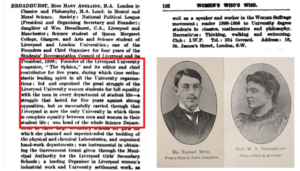
(Image – Women’s Who’s Who from 1913 states that she was a founder of The Sphinx. Inset -Ramsay Muir and Mary Adelaide Broadhurst, The Sphinx Magazine, Special Collections and Archives, University of Liverpool Library, PUB 3/2/2).
From 1894-1896 Mary Adelaide was elected as the second student president representing the female students at the college and shows that she was a natural leader and very much involved in college life, so much so that she didn’t leave the university or Liverpool for around 19 years.
The Suffrage Annual and Women’s Who’s Who’ from 1913 reveals that from 1898 – 1908 she was a reader to University students in classics, mathematics and philosophy which was an academic rank above senior lecturer and below professor, recognising a distinguished record of original research. It also states she was an “Arts and Science student of Liverpool and London” and obtained a BA in Classics and Philosophy and an MA degree in Mental and Moral Science at London University.

(Image from The Sphinx Magazine, Special Collections and Archives, University of Liverpool Library, PUB 3/2/2)
After Liverpool she took her role as president to the next level and became president of the National Political League which she established in 1911.
The main objective was to further social and political reforms on a non-party basis and one such reform was the force feeding of suffragette’s in prison and on 19th March 1913 Mary Adelaide organised a meeting to protest against force feeding at Kingsway Hall and over 1500 people attended.
Mary Adelaide never married and died in a nursing home in London 8 December 1928.
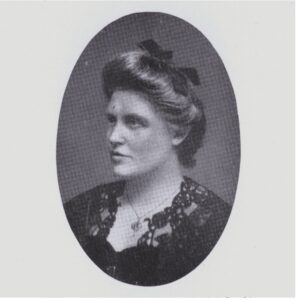
(Mary Adelaide Broadhurst, from ‘An Illustrated Who’s Who of Professional and Business Men and Women’, 1927. With thanks to Look and Learn History Picture Archive.)
In the 1913 Suffrage Annual her biography states that she was the “enthusiastic leading spirit in all the university organisations, lead and organised the great struggle of the Liverpool University women’s students for full equality with the men in every department of student life, a struggle that lasted for five years, against strong opposition, but so successfully carried through that Liverpool is now the only university in which there is complete equality between men and women in their student life.”
Ultimately her drive, determination and passion for women’s rights should definitely be noted and marked for International Women’s Day especially in relation to all that she did for the female students at our university.
During International Women’s Day find out more about Mary in a brand new history video on the VG&M YouTube Channel:
Also, watch Victoria Gallery & Museum’s Culture Bite Concert celebrating International Women’s Day below:
With special thanks to the Special Collections and Archives, University of Liverpool Library and Look and Learn History Picture Archive.
Words: Kim Fisher, Visitor Services, Victoria Gallery & Museum